Does Your Development Need Its Own Website?
RealFlow. Agency6 min read
The short answer, and the test
No, not every development needs one. A six unit building in a suburb where the developer is already known does not need a separate site. It needs a good page on the company site and someone answering the phone.
A development needs its own site when three things are true at once: buyers cannot walk past it, because it is off plan or they live abroad; the decision is large enough that people research before enquiring; and the project has a name worth building rather than a plot number.
If all three apply, the site stops being a brochure and becomes the place where advertising money either converts or leaks away.
What the site is actually for
It is the destination. That is the whole job.
When we run investor campaigns for Golden Visa eligible property, a recent thirty day period produced 207 enquiries on €690 of spend, which is €2.49 for each person who asked to be contacted. Every one of those people arrived somewhere and formed a view within about ten seconds. A separate fourteen day campaign ran at €6.64 each. The gap between those two numbers is not only targeting. It is also what the traffic landed on.
Web agencies build these sites, and most of them have never sold a unit. That is why so many development sites are beautiful and answer none of the questions a buyer actually has.
Two we built
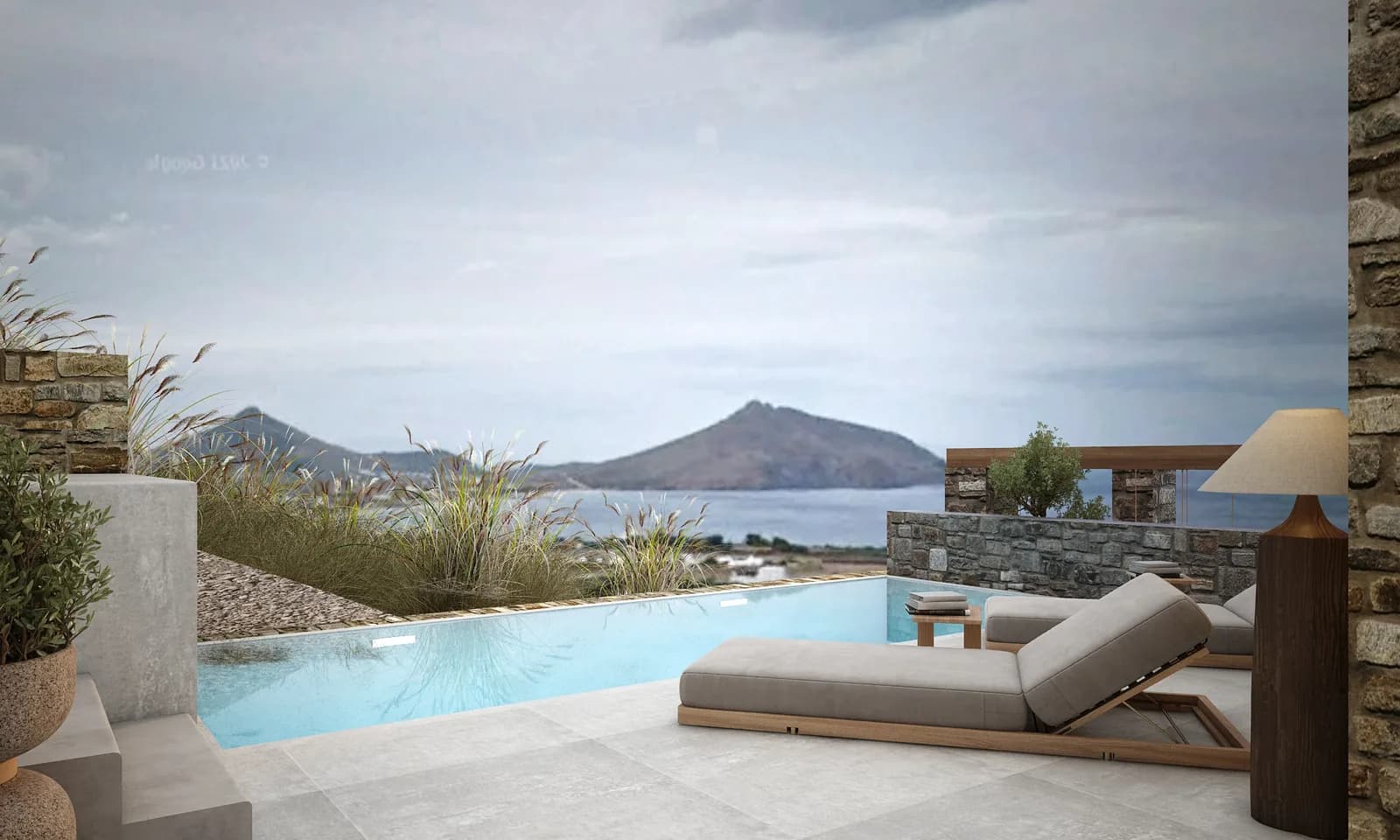
Ámaris is four turnkey villas on a slope above Isterni Bay, on the north east coast of Paros. The buyer is almost never on the island when they are deciding, so the site carries each villa separately with its own character, four bedrooms, five bathrooms, roughly 180 square metres and a guide price of €1.33 million. Someone can work out whether this is for them before they ever pick up the phone, which is the entire point.

Oneiro is eight residences on a green corner of Maroussi, designed by Besko Architects. Different buyer, different job. This one is bought by families who can visit, so the site does the work a viewing cannot: two private pools, twelve basement parking spaces, a storeroom for every residence, underfloor heating and cooling, a lift reaching every level including the parking. The unglamorous specifications are what people actually compare.

Both projects are sold largely on renders enhanced from the architectural plans, because in both cases the buildings were not finished when the marketing started.
What it has to contain
Five things, in roughly this order of importance.
Floor plans a normal person can read. Architectural drawings are made for builders. A buyer needs to understand the flow of a home in a few seconds, which usually means redrawing the plan as a furnished three dimensional view rather than exporting the technical one.
Here is the ground floor of one of the Paros villas, and the level above it:


You can see the pool, where the sun falls, which rooms open onto the terrace and how far the bedrooms sit from the living space. None of that is legible on a standard architectural drawing, and all of it is what a buyer is actually asking.
Renders that match those plans. If the render shows a terrace the plan does not have, you have taught the buyer not to trust either one.
Where it is, honestly. Distance to the sea, the metro, the school, the airport. For BriQ Properties we marketed a LEED Gold office building on Poseidonos Avenue partly on what stood next to it, because location is a feature the building cannot change.
A form that qualifies. Budget, timing and what they are looking for. A name and an email teaches you nothing and fills your day with conversations that go nowhere.
The buyer's language. Not just translation. A Chinese investor buying in Athens has different questions from a Greek family buying the same apartment, and the site should answer whichever set applies.
The mistake that costs the most
Building the site as a presentation and treating the form as decoration.
We rewrote the site copy for PersonIQ Development and wired the forms into the lead system, so every enquiry lands somewhere accountable and the response gets measured. Before that, a form submission was an email in an inbox. The advertising is the same either way. What changes is whether anybody can tell you what happened next.
If your project site has a contact form and nobody can tell you the median time to first reply, the site is not finished.
You probably already own most of it
The expensive assumption is that a project site means new production.
Ámaris and Oneiro were both built before the buildings were finished, from plans and renders rather than photography. For BriQ Properties we built the name, the identity and a full leasing brochure for a building that had architecture and no brand, using the floorplans and renders that already existed. Three of those assets alone would normally have cost around €1,200 to produce from scratch.
Most developers are sitting on the raw material: plans, renders, drone footage from the site visit, progress photographs nobody catalogued. The build cost is mostly editorial, deciding what the buyer needs to see and in what order.
When to build it
Once the design is fixed and approvals are secured, so the thing you market is the thing you deliver. That also puts the site in place before construction, which is exactly when progress footage is available and most persuasive.
Launching at completion means launching to an audience that does not exist yet.
How we build project sites
We build brochures and project websites for developers selling off plan and completed units in Greece and Cyprus, including renders enhanced from your plans, floor plans redrawn so they read at a glance, and copy in the language your buyers actually use.
Read how we named and packaged a commercial building for leasing, or tell us about your project and we will say honestly whether a separate site is worth it.
Frequently asked questions
Does every property development need its own website?
No. A small local project by a developer buyers already know is usually better served by a strong page on the company site. A separate site earns its cost when the property cannot be visited yet, when buyers are researching from abroad, or when the project has a name worth building in its own right.
What should a development website include?
Five things: floor plans redrawn so a non specialist can read them, renders that match those plans exactly, honest location context, a form that asks about budget and timing, and copy in the buyer's own language. Anything else is decoration, and decoration is what most development sites are made of.
Are 3D floor plans worth producing?
For off plan sales, yes. A furnished three dimensional plan shows the flow of a home, where the light falls and how the outdoor space connects, in a few seconds. A technical architectural drawing shows none of that to a buyer, because it was drawn for the people building the thing rather than the people buying it.
Can you build a project website before the building exists?
Yes, and that is usually when it is needed most. Ámaris on Paros and Oneiro in Maroussi were both marketed from architectural plans and enhanced renders while construction was still under way, because the buyers were making decisions long before there was anything finished to photograph.
How much does a project website cost?
It depends almost entirely on what already exists. Most developers already own plans, renders and site footage, which is the expensive part. For one commercial project we reworked existing material rather than commissioning new, and three assets alone would have cost around €1,200 to produce from scratch.
When should a developer launch the project website?
Once the design is fixed and approvals are in place, so what you market matches what gets delivered. That timing also means the site exists during construction, when progress footage is available and proves the project is real, rather than after completion when there is no audience yet.